On-Site ECSI Training for Colorado Manufacturing Facilities
What Safety Officers, HR Managers & Operations Leaders Need to Know About ECSI Certification, OSHA Compliance, and Getting Your Workforce Trained Without Stopping the Line
Manufacturing Facilities Are High-Hazard Workplaces — and Your Workforce Deserves Better Than a Compliance Checkbox
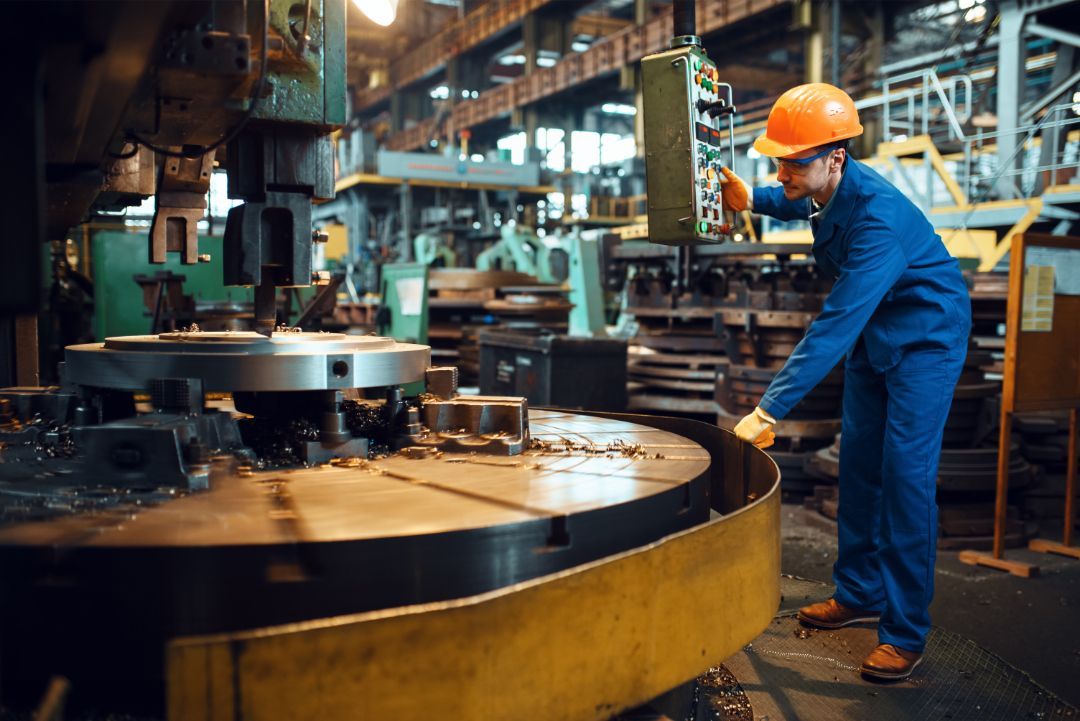
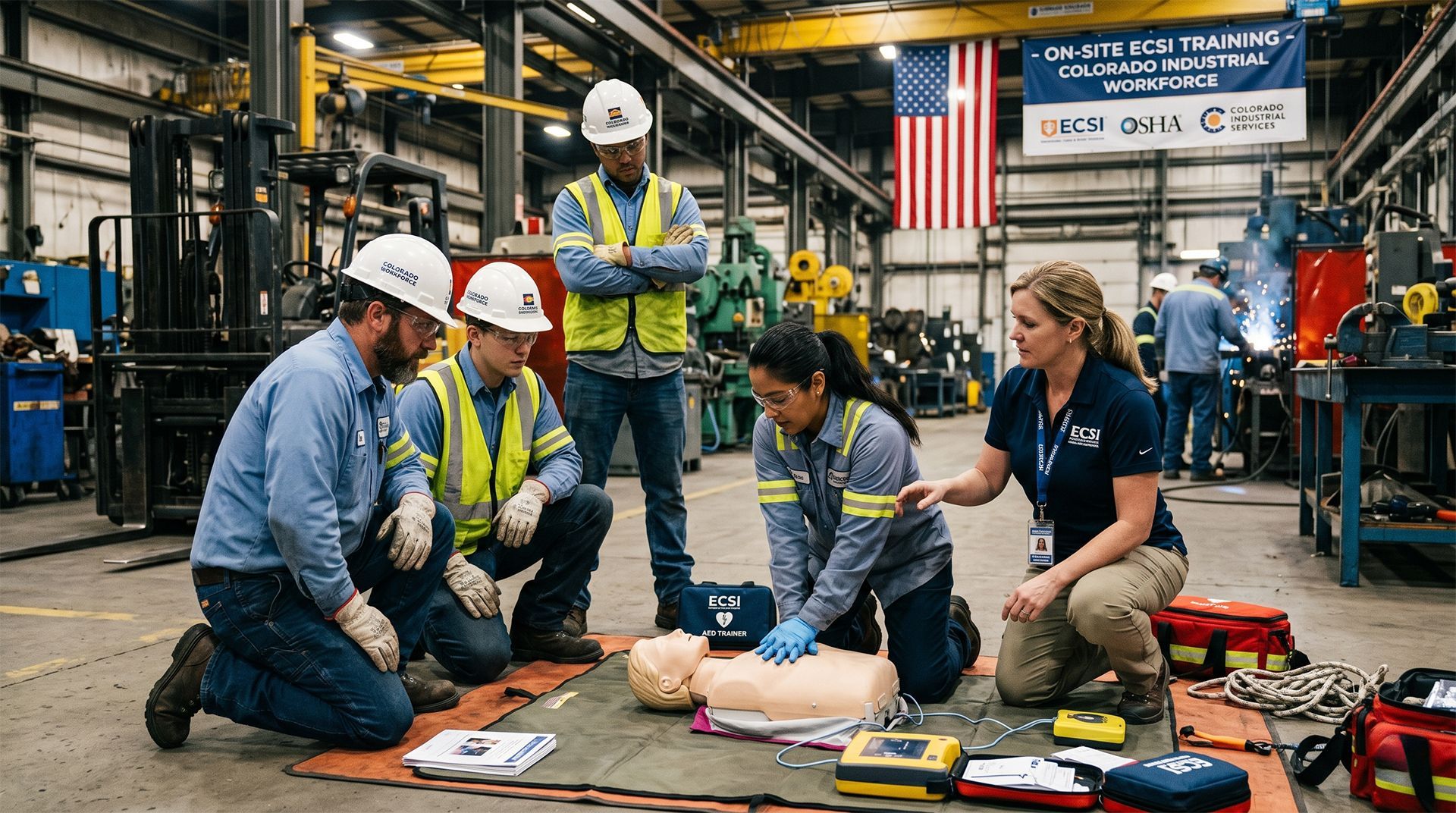
If you are a safety officer, HR manager, or operations leader at a Colorado manufacturing facility, you understand the reality of the environment your team works in every day. Manufacturing floors are busy, high-hazard workplaces — running machinery, moving materials, chemical processes, elevated platforms, powered industrial trucks — where a serious injury can happen without warning and where the minutes between an incident and the arrival of emergency medical services are not empty time. They are the minutes that determine whether a worker arrives at the hospital in the best possible condition EMS can deliver. If you are reading this because you need to get your team ECSI certified and you want to do it right — at your facility, with your actual workforce, from a provider whose credentials will hold up to OSHA scrutiny — Rapid Rescue CPR & Safety Training Solutions is the authorized ECSI Education Center built for exactly that.
What you will find in this article is practical, detailed information: what OSHA specifically requires of Colorado manufacturing employers, what the leading hazard categories in manufacturing mean for your facility's emergency preparedness, which ECSI courses make the most sense for production teams and their designated responders, and how to get your people trained without halting operations.
Rapid Rescue brings the classroom to your facility floor. You focus on keeping the line running. They handle everything else.
344
Fatal work injuries occurred in the manufacturing sector in 2022 — the most recent year of complete data from the Bureau of Labor Statistics Census of Fatal Occupational Injuries.
3–4 min
OSHA has interpreted 'near proximity' under 29 CFR 1910.151 to mean that emergency care must be reachable within 3–4 minutes for life-threatening incidents — a benchmark that many large manufacturing facilities cannot meet with external EMS alone, regardless of their urban location.
~10,000
Workplace cardiac arrests occur in the United States annually, according to OSHA data — making trained on-site responders a critical factor in any manufacturing facility's emergency preparedness plan.
Why a Manufacturing Facility Is Not Like Any Other Workplace for Emergency Response

A manufacturing environment presents emergency response challenges that are distinct from nearly every other work setting — and those challenges do not disappear simply because your facility is located in an industrial park six miles from a Denver trauma center. The size and layout of a large manufacturing facility can mean that an emergency occurring in a far corner of a production floor or warehouse bay is effectively as remote as a rural worksite, even when your address is in Aurora or Commerce City. EMS arrival at the building entrance is not EMS arrival at your worker’s side. The distance from your facility’s front door to the location of the incident — across production bays, through warehouse aisles, down restricted corridors — adds minutes that matter enormously in a cardiac arrest or severe bleeding event.
This is the gap that on-site ECSI training through Rapid Rescue is built to close. A trained team member who is already on the floor, who already knows the layout, who already has the skills to act immediately — is in a fundamentally different position to respond than any external resource. They can stabilize the patient, maintain their condition, and give EMS the best possible situation to work with when they arrive. That is the role ECSI training through Rapid Rescue prepares your team for: not to replace professional emergency medical services, but to ensure that the critical window between an incident and EMS arrival is used as effectively as possible.
Colorado’s manufacturing sector is substantial and growing. Facilities along the Aurora–Denver corridor, the I-70 industrial belt, the Fort Collins and Loveland manufacturing base, and the state’s aerospace, food processing, metal fabrication, and medical device manufacturing clusters all share this common reality. ECSI training through Rapid Rescue delivers the same high standard of authorized, credentialed certification to all of them — on-site, at your facility, on your schedule.
What OSHA Actually Requires of Colorado Manufacturing Employers

Understanding your regulatory obligations under OSHA is the starting point for building a compliant and effective emergency preparedness program for your manufacturing operation. The requirements under general industry standards are clear, and ECSI certification through Rapid Rescue as an authorized Education Center directly satisfies them.
The Core Requirement: 29 CFR 1910.151
The primary OSHA standard governing medical services and first aid in general industry — which includes manufacturing — is 29 CFR 1910.151. Under 29 CFR 1910.151(a), the employer shall ensure the ready availability of medical personnel for advice and consultation on matters of plant health. Under 29 CFR 1910.151(b), the standard states: in the absence of an infirmary, clinic, or hospital in near proximity to the workplace which is used for the treatment of all injured employees, a person or persons shall be adequately trained to render first aid. Adequate first aid supplies shall be readily available.
OSHA has interpreted ‘near proximity’ to mean that emergency medical care must be accessible within 3–4 minutes for life-threatening emergencies. This interpretation — established through OSHA letters of interpretation and enforcement decisions — is the practical standard against which your facility’s emergency response capability will be measured in the event of an inspection or incident review. For most manufacturing facilities, even those with urban addresses, external EMS cannot reliably reach an injured worker on the production floor within that window. The practical implication is direct: having trained first aid responders on-site during all operating hours is not optional — it is the standard OSHA expects you to meet.
ECSI certification issued by Rapid Rescue as an authorized Education Center constitutes documented equivalent training of the type 29 CFR 1910.151 requires. Your employees’ ECSI course completion cards are the documentation an OSHA compliance officer will look for.
Additional Requirements: Chemical Exposure and Eye/Face Wash Stations
For manufacturing facilities where employees may be exposed to injurious or corrosive materials, 29 CFR 1910.151(c) imposes an additional requirement: suitable facilities for quick drenching or flushing of the eyes and body shall be provided within the work area for immediate emergency use. This regulation works in parallel with first aid training requirements. Having emergency eyewash and shower stations is a structural requirement; knowing how to assist an exposed worker, manage the first minutes of a chemical exposure, and communicate the nature of the exposure to incoming EMS is a training requirement. ECSI’s Basic First Aid and Advanced First Aid courses both address first response to chemical and substance exposure in the context of what a lay responder can and should do before professional medical care arrives.
Broader Compliance Context: Emergency Action Plans
OSHA’s 29 CFR 1910.38 requires that general industry employers with more than ten employees maintain a written Emergency Action Plan (EAP), which must include procedures for reporting emergencies, employee actions during an emergency, and evacuation routes and procedures. A first aid training program with certified on-site responders is a core component of any credible EAP. When an OSHA compliance officer reviews your facility’s emergency preparedness, they are looking not just at the existence of an EAP on paper, but at whether the people named in it are actually trained and currently certified. ECSI certification through Rapid Rescue provides that documented, credentialed foundation.
Colorado Falls Under Federal OSHA Jurisdiction
Colorado does not operate a state-plan OSHA program. Federal OSHA standards — including 29 CFR 1910.151 — apply directly to all private-sector manufacturing employers in the state. OSHA penalties for non-compliance with first aid requirements can range from thousands to hundreds of thousands of dollars per violation. More significantly, non-compliance means your team is working without the safety foundation that trained, on-site responders provide. The cost of getting your facility ECSI certified through Rapid Rescue is a fraction of the exposure a single OSHA citation creates — and an immeasurably smaller fraction of the cost, in every sense, of an emergency where no one on the floor knew what to do.
⚠️ Important Notice
The information in this article is provided for general educational purposes only and does not constitute legal, regulatory, or professional safety advice. OSHA requirements vary by industry, facility type, and specific hazard conditions. Colorado manufacturing employers should consult a qualified occupational safety professional, legal counsel, or contact OSHA directly at osha.gov to determine the specific training, documentation, and compliance requirements applicable to their operations.
Manufacturing's Leading Injury Hazards: What Your ECSI Training Needs to Prepare Your Team For
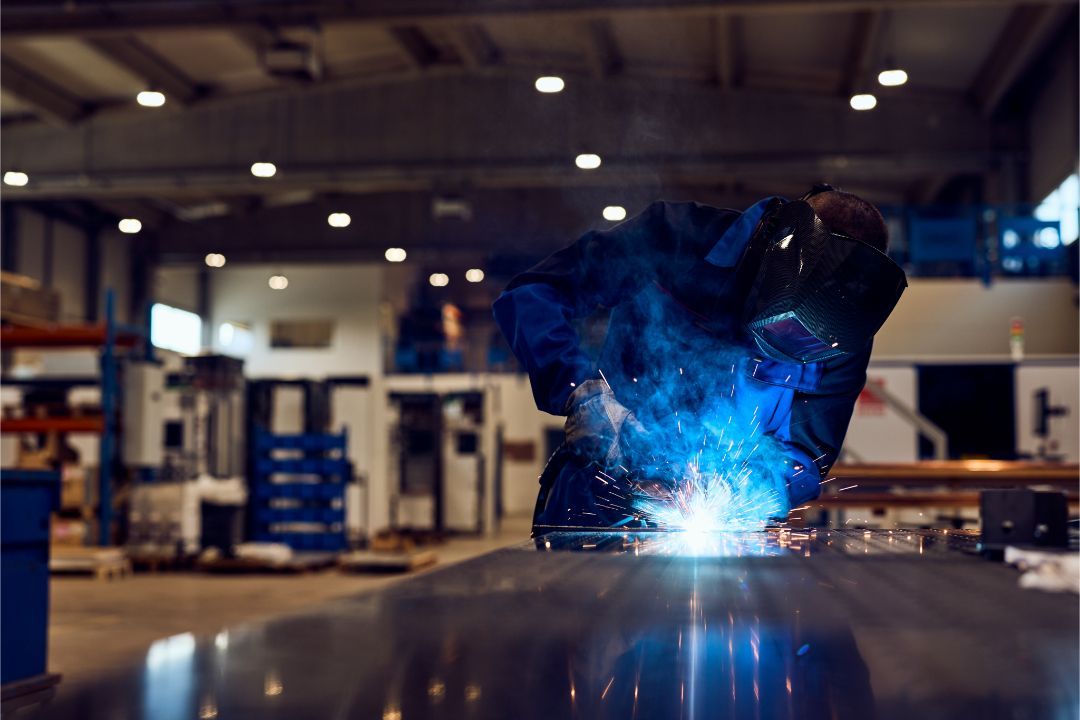
Manufacturing facilities present a distinct set of emergency scenarios that trained on-site responders need to be ready to manage. Unlike an office environment where medical emergencies are primarily cardiac or diabetic in nature, manufacturing floors combine machinery, chemicals, elevation, electrical systems, and powered vehicles in ways that produce high-severity, complex-trauma incidents. The following hazard categories represent the most significant emergency response challenges in the manufacturing environment — and the scenarios that ECSI training through Rapid Rescue is specifically designed to prepare your team to handle.
| Hazard Category | What a Trained Crew Member Does |
|---|---|
| Machinery & Equipment Contact | Controls severe bleeding from lacerations or amputations, manages crush injury, assesses for shock, maintains airway, prepares patient for EMS handoff |
| Falls Within Facility | Assesses for head and spinal injuries, manages airway of unconscious worker, controls bleeding, stabilizes patient position, monitors responsiveness until EMS arrives |
| Chemical Exposure | Removes casualty from exposure area (if safe), manages contaminated skin or eye exposure, monitors airway and breathing, communicates exposure details clearly to EMS |
| Forklift & Material Handling Incidents | Assesses for multiple-trauma injuries, manages severe bleeding, stabilizes suspected spinal injuries, prepares patient for EMS handoff without unnecessary movement |
| Electrical Contact / Arc Flash | Ensures scene is safe before approach, initiates CPR immediately (electrical contact frequently causes cardiac arrest), uses AED, manages burns |
| Confined Space Emergencies | Coordinates with external rescue team, manages patient handed out of confined space, provides CPR/AED if needed, communicates condition to EMS on arrival |
Each of these scenarios shares a common thread: the minutes between the incident and EMS arrival are not empty minutes. They are the minutes during which a trained, capable responder can stabilize a patient, maintain their condition, and package them for the care that professional emergency services are coming to provide. ECSI training through Rapid Rescue prepares your team to use those minutes effectively — not because they reviewed a safety poster during onboarding, but because they practiced the skills, hands-on, with a qualified instructor who made sure the training stuck.
Machinery Contact and Amputation: The Critical Importance of Hemorrhage Control
Machinery-related injuries — including amputations, severe crush injuries, and traumatic lacerations from equipment contact — are among the most common causes of serious harm in manufacturing environments. These injuries share one critical characteristic: severe bleeding. In a major hemorrhage event, the window during which intervention makes a meaningful difference is short, and it begins at the moment of injury, not when EMS arrives. A trained team member who knows how to apply direct pressure correctly, manage severe extremity bleeding, recognize and respond to shock, and communicate the nature of the injury to emergency dispatchers can do more to stabilize a patient in those first minutes than any amount of equipment or protocols can compensate for afterward. ECSI’s Basic First Aid and Advanced First Aid courses cover hemorrhage control as a core skill — practiced on equipment, with feedback, until it is automatic.
Cardiac Arrest and AED Response: The Four-Minute Window on the Production Floor
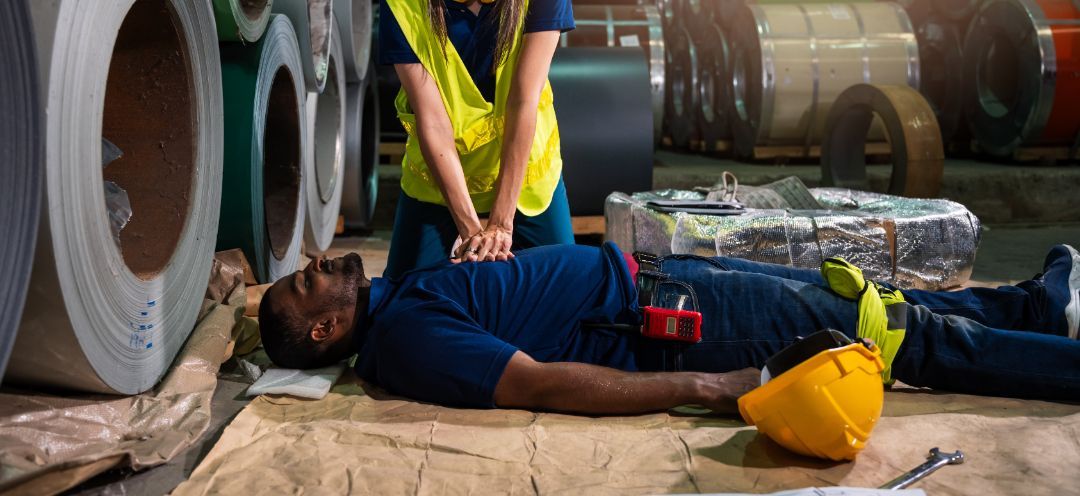
Workplace cardiac arrest can occur in any environment — from physical exertion, electrical contact, chemical exposure, traumatic shock, or underlying medical conditions that manifest during a shift. In manufacturing environments, where electrical hazards and physical demands are both present, the risk profile is meaningful. The critical factor in any cardiac arrest event is time: for every minute that passes without defibrillation in a shockable cardiac arrest, the probability of a positive outcome falls substantially. On a large manufacturing floor where an AED may be mounted at the far end of a production bay, and where EMS response to the worker’s exact location may take eight to twelve minutes after dispatch, a trained team member who can recognize cardiac arrest, begin CPR immediately, retrieve and deploy an AED, and sustain high-quality compressions until EMS arrives is giving that worker the best possible situation for the care EMS is coming to provide.
This is precisely why OSHA’s interpretation of 'near proximity' uses the four-minute benchmark — and why on-site AED availability combined with trained personnel is the standard that regulators, insurers, and medical authorities uniformly recommend for manufacturing environments. ECSI CPR and AED training through Rapid Rescue ensures that your team members are the people on your floor who act when they need to, with the skills to do it right.
Chemical Exposure: What First Response Looks Like Before EMS Arrives
Manufacturing facilities that use chemicals — cleaning agents, solvents, acids, caustic compounds, or process chemicals — require trained on-site responders who understand what to do, and what not to do, in the first minutes of an exposure event. Moving a contaminated worker away from the exposure source safely, ensuring immediate irrigation of affected skin or eyes using eyewash stations, managing the airway of a worker who has inhaled a hazardous substance, and communicating the precise nature of the exposure to EMS before they arrive are all skills that make a measurable difference in the outcome of a chemical injury. ECSI first aid training through Rapid Rescue equips your designated responders with the systematic approach to chemical exposure first response that these scenarios require — grounded in the same emergency medicine principles that ECSI programs are built on.
Which ECSI Courses Are Right for Your Manufacturing Team?
Not every member of your manufacturing workforce needs the same level of training — and Rapid Rescue will help you identify the right combination for your facility when you make contact. The following framework gives safety officers and HR managers a clear starting point for planning an ECSI training program that is appropriately scaled to your facility size, hazard profile, and compliance requirements.
| ECSI Course | Best Suited For in Manufacturing Facilities |
|---|---|
| Adult, Child & Infant CPR with AED | All production and floor employees — foundational compliance certification |
| Basic First Aid | All employees — covers lacerations, burns, fractures, chemical exposure response, shock |
| CPR & First Aid Combo | Most efficient option for full-facility certification in a single on-site session |
| Advanced First Aid | Safety leads, floor supervisors, designated first responders in high-hazard areas |
CPR, AED, and Basic First Aid — Foundational Certification for Your Entire Workforce
The starting point for any manufacturing facility’s emergency preparedness program is ensuring that a meaningful percentage of the workforce — and at minimum every individual formally designated as a first aid responder — holds current CPR, AED, and Basic First Aid certification. This is the baseline that satisfies OSHA’s 29 CFR 1910.151(b) requirement for adequately trained personnel, and it is the skill set that equips any trained team member to respond effectively in the critical first minutes of a cardiac arrest, severe bleeding event, or other medical emergency. Rapid Rescue can deliver this training as a combined CPR and First Aid Combo course in a single on-site session at your facility, making it the most operationally efficient path to building a broadly trained workforce without pulling large numbers of employees off the floor for multiple training days.
ECSI certifications are valid for two years from the date of successful course completion. For manufacturing organizations managing large workforces across multiple shifts and departments, Rapid Rescue can help you build a rolling renewal calendar so that certifications never lapse simultaneously across your team — and so that newly hired employees can be slotted into an upcoming session without waiting for the next full facility training cycle. Ask about this specifically when you make initial contact.
Advanced First Aid — For Designated Facility Responders and Safety Leads
Every manufacturing facility should designate specific employees as on-site first aid responders — people whose training goes meaningfully beyond the foundational CPR and first aid that the broader workforce holds. ECSI’s Advanced First Aid course is the right next step for safety leads, floor supervisors with formal responder designations, and any employee whose role in your Emergency Action Plan involves more than calling for help and staying with the patient. Advanced First Aid covers complex patient assessment, management of traumatic injuries common to manufacturing environments (including severe lacerations, fractures, crush injuries, and suspected spinal injuries), recognition and management of shock, chemical exposure first response, and the clinical decision-making that helps a responder stabilize a patient through the full window from incident to EMS handoff. For safety officers building a multi-tier emergency response capability across their facility, Advanced First Aid is the course that creates that stronger, more capable second layer.
On-Site Delivery: How Rapid Rescue Works With Manufacturing Teams
The operational reality of manufacturing is that shutting down a production line or pulling a shift team off the floor for off-site training is not a realistic option for most operations. Rapid Rescue is specifically built to remove that friction. As an authorized ECSI Education Center, Rapid Rescue brings all necessary training equipment directly to your facility — CPR manikins, AED trainers, course materials, everything required for a complete, accredited training session. Your employees do not travel. Your operations do not pause. You designate a space — a break room, a training area, a conference room, an open bay — and Rapid Rescue delivers a professional, credentialed ECSI session right there.
Scheduling is flexible, including Saturday morning sessions for manufacturing operations that run standard weekday production schedules. For facilities with multiple shifts or departments requiring certification, Rapid Rescue can schedule back-to-back sessions at the same location in a single day, working through employee groups in rotation while operations continue. The minimum group size is six participants, and pricing scales per person rather than per course — meaning a small specialty manufacturer and a large production facility are both well served by the same straightforward pricing model.
Multi-Shift and Department-Level Training
Manufacturing facilities with 24-hour or rotating shift operations face a particular training challenge: a first aid program that only covers day shift leaves the facility without certified responders during nights, weekends, and off-peak production hours. The goal of a genuinely compliant and effective emergency preparedness program is not to have one certified person somewhere in the building — it is to have trained, certified responders distributed across the workforce and present at all times during operations. Rapid Rescue’s flexible scheduling model, including back-to-back session capability in a single day, is specifically designed to make multi-shift coverage achievable without requiring a major operational disruption. When you make initial contact, describe your shift structure and Rapid Rescue will help you design a training plan that covers your full operational footprint.
Training Records: What You Need for OSHA Compliance
As an authorized ECSI Education Center, Rapid Rescue issues official ECSI course completion cards upon successful completion of each in-person session — typically valid for two years. These cards, combined with training records that include each employee’s name, training date, course content covered, training provider name, instructor’s name, and certification expiration date, are the documentation an OSHA compliance officer will request when reviewing your facility’s medical services and first aid compliance under 29 CFR 1910.151. Rapid Rescue’s certification process provides all of this documentation the same day your employees complete training — no delays, no waiting for paperwork to catch up to your audit calendar. Your records are current and complete from the moment your team walks out of the session.
Why Manufacturing Companies Choose Rapid Rescue
Safety officers and operations leaders who have worked with Rapid Rescue consistently point to the same things: the quality of the instructors, the practical relevance of the training to the manufacturing environment, and the straightforwardness of the entire experience from first contact to certification.
Rapid Rescue’s instructors are seasoned healthcare providers with real-world emergency experience and a genuine ability to connect with the working adults in front of them. They understand that manufacturing employees are practical, experienced people who respond to training that feels grounded in the actual hazards of their environment — not classroom theory delivered to a generic audience. Rapid Rescue’s instructors adapt their delivery to the people in the room, and the result is training that team members retain and feel genuinely confident applying when a real situation demands it.
As an authorized ECSI Education Center, Rapid Rescue delivers training under ECSI’s rigorous quality standards — with course content developed in association with the American Academy of Orthopaedic Surgeons (AAOS) and the American College of Emergency Physicians (ACEP), consistent with ILCOR recommendations and meeting or exceeding AHA guidelines. That is the medical credibility behind every certification your employees receive. And Colorado’s Good Samaritan Law provides those employees with legal protection when they use their training to assist a colleague in an emergency — acting in good faith without expectation of payment is protected under Colorado law, giving your trained team members the confidence to step in without hesitation.
How to Book Your On-Site ECSI Training
Getting started takes about five minutes. There are two ways to make first contact with Rapid Rescue:
- Fill out the on-site group training inquiry form
- Email the team directly at info@rapidrescuetraining.com
Office hours are Monday through Friday, 9am to 4pm. When you reach out, you will connect with a real person who wants to understand your facility — your workforce size, your shift structure, your specific hazard profile, your OSHA compliance requirements, and your preferred scheduling window. Rapid Rescue will help you identify the right ECSI course combination for your team, plan the logistics of on-site delivery, and get a date confirmed. From there, they handle everything. You just need to let your team know when to show up.
If you are not yet sure which courses your facility needs, or how to structure training across multiple shifts or departments, reach out anyway. That is exactly the conversation Rapid Rescue is set up to have, and they will help you work through the right approach for your specific operation without pressure.
ECSI Training for Colorado Manufacturing Facilities
Colorado’s manufacturing sector employs tens of thousands of workers across facilities that range from small specialty shops to large multi-building production campuses — and all of them share the same fundamental reality: manufacturing is a high-hazard environment where serious injuries happen, where the layout and scale of a facility mean that external EMS cannot always reach an injured worker as quickly as the situation demands, and where the difference between a well-managed emergency and a preventable tragedy often comes down to whether a trained, capable person was present and ready to respond. ECSI training through Rapid Rescue puts certified, confident responders on your floor — people who have practiced the skills with their hands, who know what to do under pressure, and who will act when it counts.
As an authorized ECSI Education Center, Rapid Rescue delivers training that is OSHA compliant, medically credible, and genuinely relevant to the manufacturing environment. Their instructors come to your facility, bring everything needed, work around your schedule, and leave your team better prepared than when they arrived. The documentation is complete. The certifications are immediate. Your compliance requirements are met — and more importantly, your people are ready.
Reach out today through the inquiry form at
rapidrescuetraining.com or email
info@rapidrescuetraining.com. Your team shows up every shift ready to build, process, fabricate, and produce. Make sure they are also ready to respond.
📋 Legal Disclaimer
The information in this article is provided for general educational purposes only and does not constitute legal, regulatory, or professional safety advice. OSHA requirements, certification standards, and applicable laws vary by industry, workplace type, and jurisdiction. Colorado employers should consult a qualified occupational safety professional, legal counsel, or contact OSHA directly at osha.gov to determine the specific training, documentation, and compliance requirements applicable to their organization. For ECSI program standards, visit ecsinstitute.org.
Frequently Asked Questions About ECSI for Manufacturing
Q: Does OSHA require every manufacturing employee to have first aid certification?
A: Not every employee individually, but OSHA’s 29 CFR 1910.151(b) requires that in the absence of a medical facility in near proximity, a person or persons shall be adequately trained to render first aid. OSHA’s interpretation of ‘near proximity’ requires that emergency care be available within 3–4 minutes for life-threatening incidents. For the vast majority of manufacturing facilities — even those in urban industrial parks — that benchmark cannot be met by external EMS alone, given the internal distances within large facilities. The practical standard is to have trained, certified first aid responders distributed across your workforce and present on the floor during all operating hours. The number of trained responders that is appropriate depends on your facility size, hazard profile, and shift structure. When you contact Rapid Rescue, they can help you think through the right coverage model for your specific operation.
Q: Are ECSI certifications accepted by OSHA for manufacturing compliance?
A: Yes. OSHA’s 29 CFR 1910.151(b) requires that personnel be ‘adequately trained to render first aid.’ ECSI certification issued by Rapid Rescue as an authorized Education Center constitutes that documented adequate training. ECSI programs are developed in association with the American Academy of Orthopaedic Surgeons (AAOS) and the American College of Emergency Physicians (ACEP), are consistent with ILCOR recommendations, and meet or exceed AHA guidelines. The ECSI course completion cards issued by Rapid Rescue are the documentary evidence of training completion that OSHA compliance frameworks expect. Always confirm the specific obligations for your facility type and hazard conditions with a qualified safety professional or at osha.gov.
Q: How long does a typical on-site ECSI training session take at a manufacturing facility?
A: Session length varies by course and group size. A combined CPR and First Aid course for a group of six to twenty participants typically runs two to four hours, depending on the specific content covered and the number of employees in the session. Advanced First Aid courses are longer. When you contact Rapid Rescue through the inquiry form or via email, they will give you a realistic time estimate based on your group size and the courses you need, so you can plan your production schedule and shift rotations accordingly.
Q: Our facility runs three shifts. Can Rapid Rescue cover all of them?
A: Yes. On-site delivery is specifically designed for exactly this kind of scheduling challenge. Because Rapid Rescue comes fully equipped to your facility, running back-to-back sessions in a single day — covering day shift, swing shift, and night shift employees in sequential groups — is logistically straightforward. For facilities with very large workforces, multiple training days can be scheduled across a week or month to cover the full workforce without ever requiring a major operational disruption. When you reach out, describe your shift structure and workforce size and Rapid Rescue will help you design the most efficient training approach for your facility.
Q: What records does Rapid Rescue provide, and what do we need to keep for OSHA compliance?
A: Rapid Rescue issues official ECSI course completion cards on the day of training — no waiting period. For a complete OSHA-compliant training record, you should maintain documentation that includes each employee’s name, training date, course content covered, provider name, instructor name, and certification expiration date. Rapid Rescue’s certification process provides the information needed to build those records immediately. For safety officers and HR managers who need to be ready for an inspection on short notice, having clean, current training records is a straightforward exercise when your certification process is managed by an authorized provider like Rapid Rescue. Contact the team via the inquiry form at rapidrescuetraining.com or email info@rapidrescuetraining.com to get started.
Q: We have employees who travel between multiple Colorado facilities. How do we manage certifications across locations?
A: ECSI certifications are issued to the individual employee and are valid for two years from the date of successful course completion — they are not site-specific. For manufacturing organizations managing multi-facility operations across Colorado, each employee’s ECSI course completion card serves as portable documentation of their training status. When you contact Rapid Rescue, discuss your multi-facility structure — they can help you design a certification and renewal schedule that keeps your workforce trained and documented across all locations in a coordinated, manageable way.
Ready to Bring ECSI Training to Your Colorado Manufacturing Team?
Fill out our on-site training inquiry form
Or email us directly: info@rapidrescuetraining.com
Office Hours: Monday–Friday, 9am–4pm