On-Site ECSI Training for Colorado Oil and Gas Operations
Oil and Gas Sites Are Remote, High-Hazard Worksites — and Your Crew Deserves More Than a Compliance Checkbox

If you are a safety officer, HSE manager, or operations leader in Colorado’s oil and gas sector, you already understand a reality that does not apply in most other industries: the worksite is often genuinely remote. Whether your operations are on the Weld County drilling fields, the Western Slope’s Piceance Basin, a pipeline corridor through rural terrain, or a production facility miles from the nearest paved road, the distance between an incident and the arrival of professional emergency medical services is measured very differently than it is in a city or a suburban industrial park.
If you are reading this because you need to get your crew ECSI certified and you want to do it in a way that reflects the actual conditions your people work in — at your site, with training that goes beyond a basic compliance card, from a provider whose credentials hold up to OSHA scrutiny — Rapid Rescue CPR & Safety Training Solutions is the authorized ECSI Education Center built for exactly that.
What you will find in this article is practical, detailed information: what OSHA requires of Colorado oil and gas employers, what the leading hazard categories in oil and gas operations mean for your crew’s emergency preparedness, why remote-site training like Wilderness First Aid matters specifically for this industry, and how to get your people trained without pulling them off a producing site for days at a time.
Rapid Rescue brings the classroom to your location — whether that location is a yard in Greeley or a well pad an hour from the nearest hospital.
20–30 min
Estimated EMS response time for many remote Colorado oil and gas sites — well beyond OSHA’s 3–4 minute ‘near proximity’ benchmark, making trained on-site responders an operational necessity, not a convenience
~10,000
Workplace cardiac arrests occur in the United States annually, according to OSHA data — a risk that exists in every industry, but one that carries far greater consequences on a site where EMS arrival is delayed.
100%
ECSI CPR and first aid training is fully OSHA compliant and accepted by hundreds of regulatory authorities throughout the United States, giving HSE managers documented assurance their training program will hold up under audit.
Why an Oil and Gas Worksite Is Not Like Any Other Workplace for Emergency Response
Colorado’s oil and gas sector operates across an enormous and varied geography — from the dense drilling activity of Weld County to the more isolated terrain of the Western Slope’s Piceance Basin, along pipeline corridors that cross open country, and at production facilities that may sit far from the nearest paved road, let alone the nearest hospital.
This is the defining operational reality that separates oil and gas emergency preparedness from almost every other industry: the gap between an incident occurring and professional EMS arriving on scene is not a matter of a few minutes. It can be twenty minutes, thirty minutes, or more — and that gap does not shrink because the situation is serious. It only becomes more consequential.
This is the gap that on-site ECSI training through Rapid Rescue is built to close. A field crew member who already knows the site, who is already standing nearby, and who has the training to act immediately is in a fundamentally different position than any external resource arriving thirty minutes later.
They can stabilize the patient, manage the injury or illness through an extended waiting period, and prepare the patient to be handed off in the best possible condition when EMS — or a medevac — finally arrives. That is the role ECSI training through Rapid Rescue prepares your crew for: not a replacement for professional emergency care, but the critical bridge across a gap that, in this industry, is often measured in tens of minutes rather than single digits.
What OSHA Actually Requires of Colorado Oil and Gas Employers

Understanding your regulatory obligations under OSHA is the starting point for building a compliant and genuinely effective emergency preparedness program for your operation. The requirements are clear, and ECSI certification through Rapid Rescue as an authorized Education Center directly satisfies them.
The Core Requirement: 29 CFR 1910.151
Oil and gas extraction, production, and midstream operations fall under OSHA’s general industry standard, 29 CFR 1910.151, the same standard that broadly governs medical services and first aid for general industry employers. Under 29 CFR 1910.151(b), in the absence of an infirmary, clinic, or hospital in near proximity to the workplace, a person or persons shall be adequately trained to render first aid, and adequate first aid supplies shall be readily available.
OSHA has interpreted ‘near proximity’ to mean that emergency medical care must be available within approximately 3–4 minutes for life-threatening emergencies. For the overwhelming majority of Colorado oil and gas worksites — drilling pads, remote production facilities, pipeline rights-of-way — that benchmark is simply not achievable through external EMS alone. The practical and legal implications are direct: a trained, certified first aid responder must be present on site during operations, because professional emergency services cannot reliably meet the proximity standard OSHA expects employers to plan around.
ECSI certification issued by Rapid Rescue as an authorized Education Center constitutes the documented, adequate training required by 29 CFR 1910.151(b). Your crew’s ECSI course completion cards are the documentation that an OSHA compliance officer will look for during a site inspection.
Chemical and Hydrogen Sulfide (H2S) Exposure Considerations
Oil and gas operations can involve exposure to a range of process chemicals, and in certain formations, hydrogen sulfide (H2S) gas. Where corrosive or injurious materials are present, 29 CFR 1910.151(c) requires suitable facilities for quick drenching or flushing of the eyes and body within the work area for immediate emergency use.
This structural requirement works alongside training: a worker who knows how to recognize the signs of chemical or gas exposure, move a casualty to safety when it is safe to do so, and manage the first minutes of an exposure event before EMS arrives is the human element that the eyewash station and the written hazard communication plan are designed to support. ECSI’s Basic and Advanced First Aid courses address chemical exposure first response as part of the standard curriculum.
Colorado Falls Under Federal OSHA Jurisdiction
Colorado does not operate a state-plan OSHA program. Federal OSHA standards — including 29 CFR 1910.151 — apply directly to all private-sector oil and gas employers operating in the state, regardless of the remoteness of the specific worksite.
OSHA penalties for noncompliance with first-aid and medical services requirements can range from thousands to hundreds of thousands of dollars per violation.
For an industry where the consequences of an emergency response gap are magnified by distance, the investment in ECSI certification through Rapid Rescue is a small fraction of the exposure a single OSHA citation creates — and a far smaller fraction of the operational and human cost of a remote-site emergency with no trained responder present.
⚠️ Important Notice
The information in this article is provided for general educational purposes only and does not constitute legal, regulatory, or professional safety advice. OSHA requirements vary by industry, site type, and specific hazard conditions. Colorado oil and gas employers should consult a qualified occupational safety professional, legal counsel, or contact OSHA directly at
osha.gov to determine the specific training, documentation, and compliance requirements applicable to their operations.
Oil and Gas Leading Injury Hazards: What Your ECSI Training Needs to Prepare Your Crew For
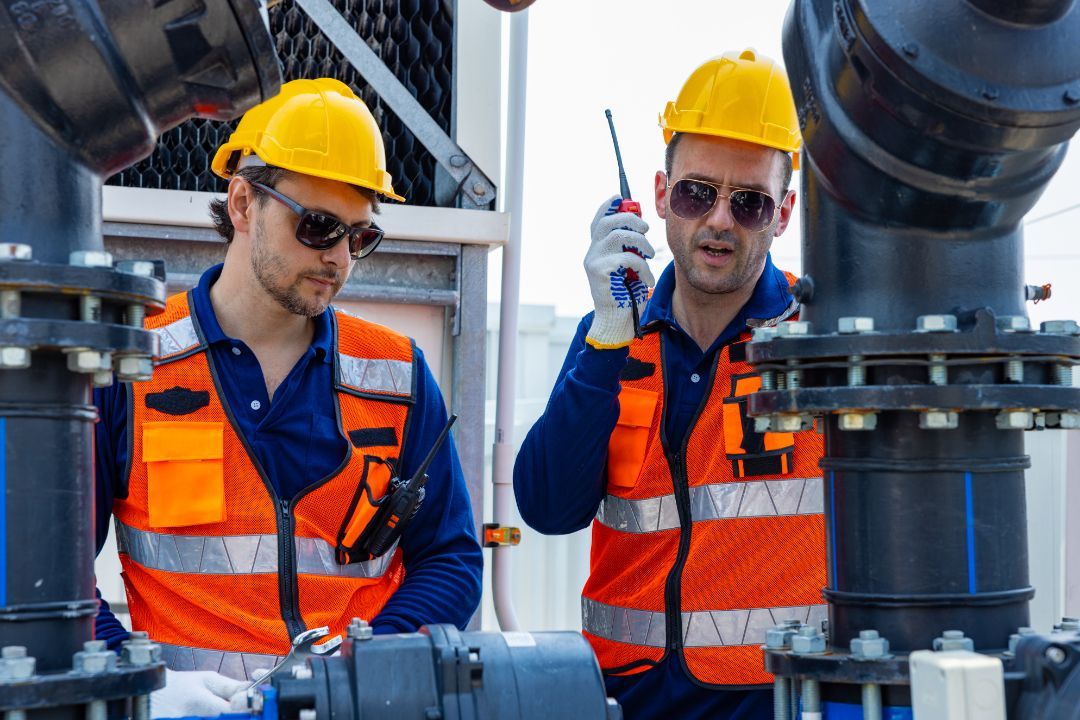
Oil and gas operations combine heavy equipment, elevated work, pressurized systems, chemical exposure, fire and explosion risk, and extreme environmental conditions — often at sites where the nearest help is a long drive or a helicopter flight away. The following hazard categories represent the most significant emergency response challenges your crew is likely to face, and the scenarios that ECSI training through Rapid Rescue is specifically designed to prepare your team to handle.
| Hazard Category | What a Trained Crew Member Does |
|---|---|
| Falls from Elevated Equipment | Assesses for head, spinal, and internal injury, manages airway, controls bleeding, stabilizes the worker, prepares patient for extended EMS response |
| Struck-By / Caught-In/Between (Rigging & Heavy Equipment) | Controls severe bleeding, manages crush injury and suspected fractures, monitors for shock, maintains airway and breathing |
| Chemical & Hydrogen Sulfide (H2S) Exposure | Removes casualty from exposure area when safe to do so, manages airway, monitors breathing and responsiveness, communicates exposure details clearly to EMS or evacuation team |
| Fires, Explosions & Flash Burns | Manages burns, assesses for airway compromise from smoke or heat exposure, controls bleeding from associated trauma, stabilizes for extended transport |
| Electrocution | Ensures scene is safe before contact, initiates CPR immediately (electrical contact frequently causes cardiac arrest), uses AED, manages burns |
| Heat-Related and Cold-Related Illness | Recognizes early signs of heat exhaustion, heat stroke, or hypothermia, initiates field cooling or warming measures, monitors vital signs, prepares for evacuation |
Each of these scenarios shares the same defining characteristic in the oil and gas context: the response window is not just the first few minutes — it is the entire stretch of time, potentially twenty minutes, thirty minutes, or longer, between the incident and EMS or medevac arrival. A trained crew member who can stabilize a patient and sustain that stabilization across an extended waiting period is doing something fundamentally different, and fundamentally more demanding, than a first aid responder in an urban facility. ECSI training through Rapid Rescue, including Wilderness First Aid for the most remote operations, is built around exactly that extended-care reality.
Extended Response Times: Why Wilderness First Aid Matters for This Industry
Standard first aid and CPR training is built around the assumption that EMS will arrive within several minutes. That assumption does not hold for many Colorado oil and gas sites. Wilderness First Aid (WFA), part of the ECSI curriculum available through Rapid Rescue, is specifically designed for situations where professional medical care is a meaningful distance — not a few minutes — away.
WFA covers patient assessment and management in remote and austere environments, improvised treatment techniques for situations where standard medical supplies may not be available, evacuation decision-making, and extended patient care protocols for the period between an incident and professional medical care arriving.
For drilling crews, pipeline workers, and field personnel operating in Colorado’s more remote oil and gas regions, WFA is the course that prepares them for the response window they actually face — not the one a standard first aid course assumes.
Fires, Explosions and Process Hazards
Oil and gas sites carry inherent fire and explosion risk from flammable hydrocarbons, pressurized systems, and electrical equipment operating in proximity to combustible materials. When an incident of this kind occurs, the resulting injuries — burns, blast trauma, smoke inhalation — require immediate, competent first response, often in an environment where the scene itself remains hazardous.
ECSI training through Rapid Rescue covers scene safety assessment, burn management, and airway management for smoke or heat-exposed patients, equipping your crew to respond to fire and explosion-related injuries without becoming additional casualties themselves.
Hydrogen Sulfide (H2S) and Toxic Gas Exposure
In formations and operations where H2S or other toxic gases are present, exposure events can progress extremely quickly and require a fast, correct response.
While site-specific H2S safety protocols and detection equipment are a separate operational requirement, the first aid response to a worker who has been exposed — managing airway and breathing, moving the casualty to fresh air when it is safe to do so.
Monitoring responsiveness and communicating clearly to EMS or evacuation personnel about the nature of the exposure is a skill set ECSI training through Rapid Rescue builds directly into Basic and Advanced First Aid coursework.
Which ECSI Courses Are Right for Your Oil and Gas Crew?

Not every member of your crew needs the same level of training — and Rapid Rescue will help you determine the right combination for your operation when you reach out. The following framework gives safety officers and HSE managers a clear starting point for planning an ECSI training program appropriate to site remoteness, crew size, and hazard profile.
| ECSI Course | Best Suited For on Colorado Oil & Gas Operations |
|---|---|
| Adult, Child & Infant CPR with AED | All field and facility personnel — foundational compliance certification |
| Basic First Aid | All field and facility personnel — covers lacerations, burns, fractures, chemical exposure response, shock |
| CPR & First Aid Combo | Most efficient option for full-crew certification in a single on-site session |
| Advanced First Aid | Site safety leads, lease operators, designated first responders at production and processing sites |
| Wilderness First Aid | Remote drilling sites, pipeline crews, and operations significant distances from hospital-level care |
CPR, AED, and Basic First Aid — Foundational Certification for Every Crew Member
The foundation of any oil and gas site’s emergency preparedness program is ensuring that every crew member — and at a minimum every individual formally designated as a first aid responder — holds current CPR, AED, and Basic First Aid certification.
This is the baseline that satisfies OSHA’s 29 CFR 1910.151(b) requirement for adequately trained personnel, and it is the skill set that equips any crew member to respond effectively in the critical first minutes of a cardiac arrest, severe bleeding event, or other emergency — minutes that matter even more when EMS is a long way off.
Rapid Rescue can deliver this training as a combined CPR and First Aid Combo course in a single on-site session, making it the most efficient path to getting your full crew certified without losing a day of operations.
ECSI certifications are valid for two years from the date of successful course completion. For oil and gas operators managing crews across multiple sites and rotating schedules, Rapid Rescue can help you build a rolling renewal calendar so that certifications across your workforce never lapse simultaneously — and so that new hires can be added ahead of the next full crew training cycle. Ask about this when you make initial contact.
Advanced First Aid — For Site Safety Leads and Designated Responders
Every oil and gas site should have at least one person — ideally more, particularly at larger or more remote sites — whose training goes beyond foundational CPR and first aid. ECSI’s Advanced First Aid course is the right next step for site safety leads, lease operators, and anyone formally designated as a first aid responder.
Advanced First Aid covers more complex patient assessment, management of traumatic injuries common to oil and gas environments — including crush injuries, fractures, burns, and suspected spinal injuries — shock recognition and management, and the clinical decision-making that helps a responder keep a patient stable through an extended window before EMS handoff.
For HSE managers building a layered emergency response capability across multiple sites, Advanced First Aid is the course that creates that stronger second tier of preparedness.
Wilderness First Aid — For Remote Drilling, Pipeline, and Field Operations
For crews working at remote drilling pads, along pipeline rights-of-way, or in any location where the question ‘how long until EMS arrives’ has an answer measured in tens of minutes rather than single digits, ECSI’s Wilderness First Aid course is the most relevant training available.
WFA goes beyond standard first aid to cover sustained patient management, environmental injuries (heat- and cold-related illness), evacuation planning, and decision-making in situations where waiting for a textbook EMS response is simply not realistic.
For Colorado oil and gas operators with field personnel in the Piceance Basin, the Weld County drilling fields, or any other remote operational area, Wilderness First Aid through Rapid Rescue is the course that aligns training with the realities of the worksite.
On-Site Delivery: How Rapid Rescue Works With Oil and Gas Operators
The operational reality of oil and gas work is that pulling a field crew off a producing site, or routing personnel to an off-site training facility hours away, is rarely practical and often genuinely impossible. Rapid Rescue is specifically built to remove that friction.
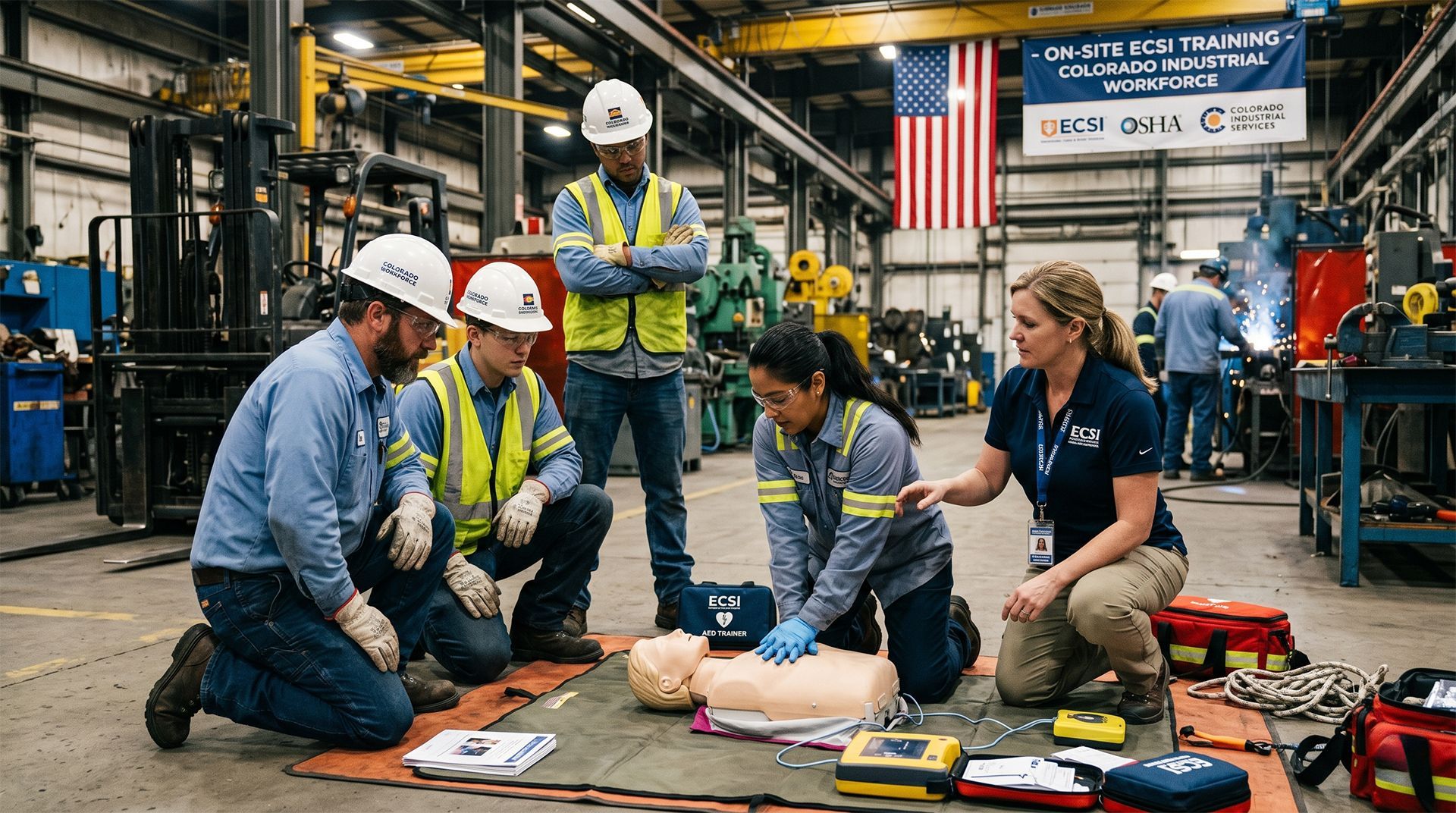
As an authorized ECSI Education Center, Rapid Rescue brings all necessary training equipment directly to your location — CPR manikins, AED trainers, course materials, everything required for a complete, accredited training session, whether that location is a company yard in Greeley, a field office, or a designated training space at the well site itself.
Scheduling is flexible, including Saturday morning sessions for crews working standard weekday rotations. For operators managing multiple crews or shifts, Rapid Rescue can schedule back-to-back sessions at the same location in a single day.
The minimum group size is six participants, and pricing scales per person rather than per course — meaning a small field operation and a large multi-site operator are both well served by the same straightforward pricing model.
Multi-Site Operators and Rotating Crews
Operators running multiple sites across Colorado—from Front Range production facilities to Western Slope drilling operations—face a particular training challenge: ensuring that first aid coverage is current at every location and on every rotation, not concentrated at headquarters while remote sites go uncovered.
Rapid Rescue’s flexible, on-site delivery model is specifically designed to make multi-site coverage achievable. When you make initial contact, describe your site locations, crew rotations, and operational footprint, and Rapid Rescue will help you design a training plan — potentially including a mix of standard ECSI courses for office and yard personnel and Wilderness First Aid for remote field crews — that covers your full operation.
Training Records: What You Need for OSHA Compliance
As an authorized ECSI Education Center, Rapid Rescue issues official ECSI course completion cards upon successful completion of each in-person session — typically valid for two years.
These cards, combined with training records that include each employee’s name, training date, course content covered, training provider name, instructor’s name, and certification expiration date, are the documentation an OSHA compliance officer will request when reviewing your operation’s medical services and first aid compliance under 29 CFR 1910.151.
Rapid Rescue’s certification process provides all of this documentation the same day your crew completes training — critical for operators who need clean, current records ready for an audit, a client contractor qualification review, or a regulatory inspection at any time.
Why Oil and Gas Operators Choose Rapid Rescue
Safety officers and HSE managers who have worked with Rapid Rescue consistently point to the same things: the quality of the instructors, the practical relevance of the training to genuinely remote and high-hazard environments, and the straightforwardness of the entire process from first contact to certification.
Rapid Rescue’s instructors are seasoned healthcare providers with real-world emergency experience, and they understand that oil and gas crews are practical, experienced people working in genuinely demanding conditions. They tailor their delivery to the specific realities of field operations — not classroom theory disconnected from the worksite. Rapid Rescue’s instructors adapt to the audience in the room, and the result is training your crew retains and feels confident applying when a real emergency, in a real remote location, demands it.
As an authorized ECSI Education Center, Rapid Rescue delivers training under ECSI’s rigorous quality standards — with course content developed in association with the American Academy of Orthopaedic Surgeons (AAOS) and the American College of Emergency Physicians (ACEP), consistent with ILCOR recommendations and meeting or exceeding AHA guidelines. That is the medical credibility behind every certification your crew receives. And Colorado’s Good Samaritan Law provides those crew members with legal protection when they use their training to assist a colleague in an emergency — acting in good faith without expectation of payment is protected under Colorado law, giving your trained personnel the confidence to act without hesitation, wherever the site happens to be.
How to Book Your On-Site ECSI Training
Getting started takes about five minutes. There are two ways to make first contact with Rapid Rescue:
- Fill out the on-site group training inquiry form
- Email the team directly at info@rapidrescuetraining.com
Office hours are Monday through Friday, 9am to 4pm. When you reach out, you will connect with a real person who wants to understand your operation — your site locations, your crew size and rotation structure, the specific hazard profile of your sites, your OSHA compliance requirements, and your scheduling constraints. Rapid Rescue will help you identify the right ECSI course combination — including whether Wilderness First Aid is appropriate for your most remote locations — plan the logistics of on-site delivery, and get a date confirmed. From there, they handle everything.
If you are not yet sure which courses your operation needs, or how to structure training across multiple sites and rotating crews, reach out anyway. That is exactly the conversation Rapid Rescue is set up to have, and they will help you think through the right approach for your specific operation without pressure.
ECSI Training for Colorado Oil and Gas Operations
Colorado’s oil and gas sector operates across some of the most geographically demanding terrain in the state — from dense Weld County drilling fields to the remote Western Slope, along pipeline corridors that stretch across open country. The one constant across all of these environments is that the gap between an incident and professional emergency care is wider here than in almost any other industry, and that gap places enormous weight on whether a trained, capable responder is already present at the moment something goes wrong. ECSI training through Rapid Rescue puts certified, confident responders on your crew — people who have practiced the skills, who understand the extended-care reality of remote-site emergencies, and who will act when it counts, for as long as it takes EMS to arrive.
As an authorized ECSI Education Center, Rapid Rescue delivers training that is OSHA compliant, medically credible, and genuinely built around the realities of oil and gas field operations — including Wilderness First Aid for the most remote sites. Their instructors come to your location, bring everything needed, work around your schedule, and leave your crew better prepared than when they arrived. The documentation is complete. The certifications are immediate. Your compliance requirements are met — and more importantly, your people are ready, wherever the job takes them.
Reach out today through the inquiry form at
rapidrescuetraining.com or email
info@rapidrescuetraining.com. Your crew shows up ready to work some of the most demanding sites in the state. Make sure they are also ready to respond.
📋 Legal Disclaimer
The information in this article is provided for general educational purposes only and does not constitute legal, regulatory, or professional safety advice. OSHA requirements, certification standards, and applicable laws vary by industry, workplace type, and jurisdiction. Colorado employers should consult a qualified occupational safety professional, legal counsel, or contact OSHA directly at
osha.gov to determine the specific training, documentation, and compliance requirements applicable to their organization. For ECSI program standards, visit
ecsinstitute.org.
Frequently Asked Questions About ECSI for Oil and Gas
Q: Does OSHA require oil and gas workers to have first aid certification?
A: OSHA’s 29 CFR 1910.151(b) requires that in the absence of an infirmary, clinic, or hospital in near proximity to the worksite, a person or persons shall be adequately trained to render first aid. OSHA’s interpretation of ‘near proximity’ sets a 3–4 minute benchmark for emergency care availability — a standard that most Colorado oil and gas sites, particularly remote drilling and pipeline locations, cannot meet through external EMS alone. The practical conclusion is that trained, certified first aid responders need to be present on site during operations. The appropriate number and level of training — including whether Wilderness First Aid is warranted — depends on the remoteness and hazard profile of the specific site. Rapid Rescue can help you assess the right coverage model for your operation.
Q: Are ECSI certifications accepted by OSHA for oil and gas industry compliance?
A: Yes. ECSI CPR and first aid training is 100% OSHA compliant. OSHA’s 29 CFR 1910.151(b) requires personnel be ‘adequately trained to render first aid,’ and ECSI certification issued by Rapid Rescue as an authorized Education Center constitutes that documented adequate training. ECSI programs are developed in association with the American Academy of Orthopaedic Surgeons (AAOS) and the American College of Emergency Physicians (ACEP), are consistent with ILCOR recommendations, and meet or exceed AHA guidelines. The ECSI course completion cards Rapid Rescue issues are the documentary evidence OSHA compliance frameworks expect. Always confirm the specific obligations for your site type and hazard conditions with a qualified safety professional or at osha.gov.
Q: What is Wilderness First Aid, and does our crew need it?
A: Wilderness First Aid (WFA) is an ECSI course designed for situations where professional medical care is a significant distance away — not a few minutes, but potentially twenty, thirty minutes or more. It covers extended patient assessment and management, evacuation decision-making, and care techniques appropriate for remote and austere environments. For crews working at remote drilling pads, pipeline corridors, or other isolated Colorado oil and gas locations, WFA is generally the more appropriate course than standard first aid alone, because it is built around the actual response timeline those sites face. When you contact Rapid Rescue, describe your site locations and they will help you determine whether WFA, standard ECSI courses, or a combination is right for your crew.
Q: Can Rapid Rescue train crews at a remote field location, or only at a company office?
A: Rapid Rescue delivers on-site training at the location that makes the most sense for your operation — a company yard, a field office, a designated training space at a well site, or any other location you specify. They bring all necessary training equipment with them, so the only requirement is a reasonably suitable space to conduct hands-on instruction. When you reach out, describe your site and Rapid Rescue will confirm logistics and what to expect.
Q: How do we coordinate training across multiple sites and rotating crew schedules?
A: This is a common challenge for multi-site oil and gas operators, and Rapid Rescue’s flexible scheduling — including back-to-back sessions in a single day and Saturday availability — is built to accommodate it. When you contact Rapid Rescue, describe your site locations, crew sizes, and rotation patterns, and they will help you design a training calendar that covers your full operation without requiring crews to be pulled off rotation for training that could instead be scheduled around their existing shift pattern. Reach out via the inquiry form or email info@rapidrescuetraining.com to start that conversation.
Q: What records does Rapid Rescue provide for OSHA compliance and contractor qualification?
A: Rapid Rescue issues official ECSI course completion cards on the day of training — no waiting period. A complete OSHA-compliant training record should include each employee’s name, training date, course content covered, provider name, instructor name, and certification expiration date. Rapid Rescue’s certification process provides this information immediately, which is particularly useful for oil and gas operators who frequently need to provide proof of current first aid training to client companies, contractor qualification systems, or regulatory inspectors with little advance notice.
Ready to Bring ECSI Training to Your Colorado Oil & Gas Team?
Fill out our on-site training inquiry form
Or email us directly: info@rapidrescuetraining.com
Office Hours: Monday–Friday, 9am–4pm